I have been looking into AI tools for digital marketing. I found that most lists include tools like ChatGPT, Jasper and Canva. What I did not find is someone explaining how these tools fit into a working process and where they do not work.
I have been using AI tools for digital marketing for my work including content research, keyword clustering and improving content. This is my method, including an example of how it changed my work and the errors I made and fixed along the way.
AI tools for digital marketing are important now because digital marketing is about doing more with the time we have. We need to create content, run more campaigns and understand more data. AI tools do not replace that work; they just make the time it takes to go from idea to draft shorter.
AI Tools for Digital Marketing: How I Use Them
The problem is that most people either use AI too much or too little. They publish the output without checking it or use it as a toy. The best place is in between.
My real AI marketing process includes the set of tools I actually use. I will explain what each tool is for.
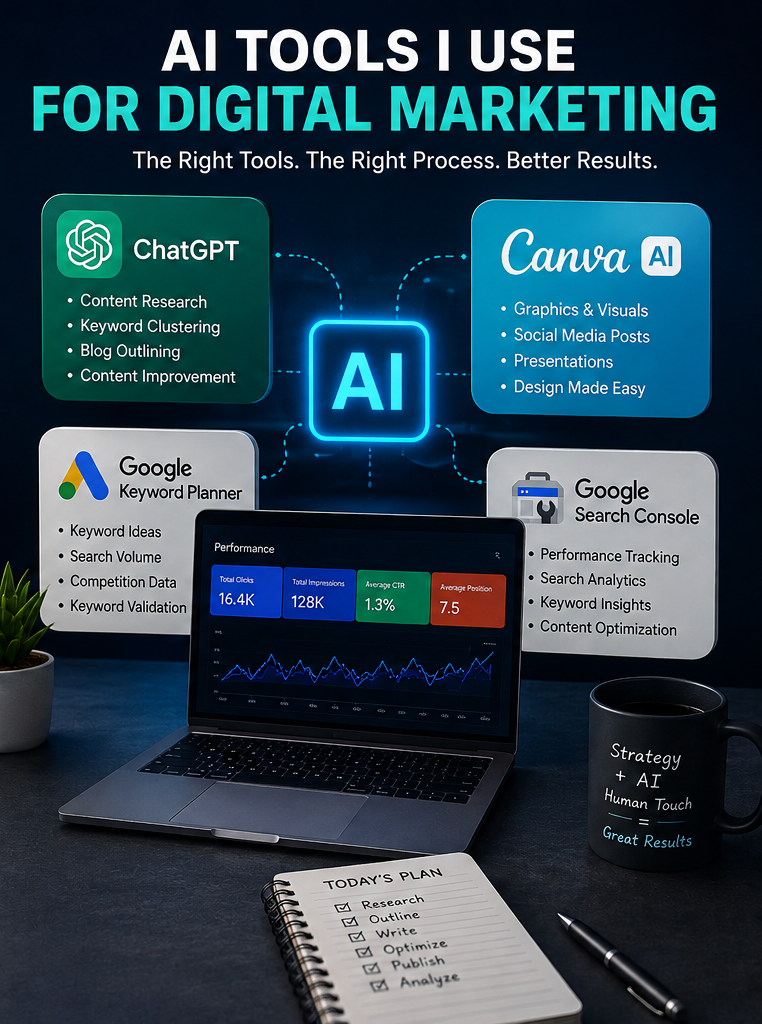
The AI Tools I Use
My real AI tools for digital marketing process includes the set of tools I actually use. I will explain what each tool is for.
I use ChatGPT for content research, keyword clustering, blog outlining and improving content.
I use Canva AI for media graphics and presentation design.
I use Google Keyword Planner for keyword volume and research.
I use Google Search Console for tracking performance and getting insights.
How ChatGPT Fits Into My Process
ChatGPT is part of my process. I use it to come up with ideas, build SEO content structures and make the text easier to read. I never think the output is complete. I always change it so it sounds like me and gives value to the reader.
How I Use ChatGPT for Content
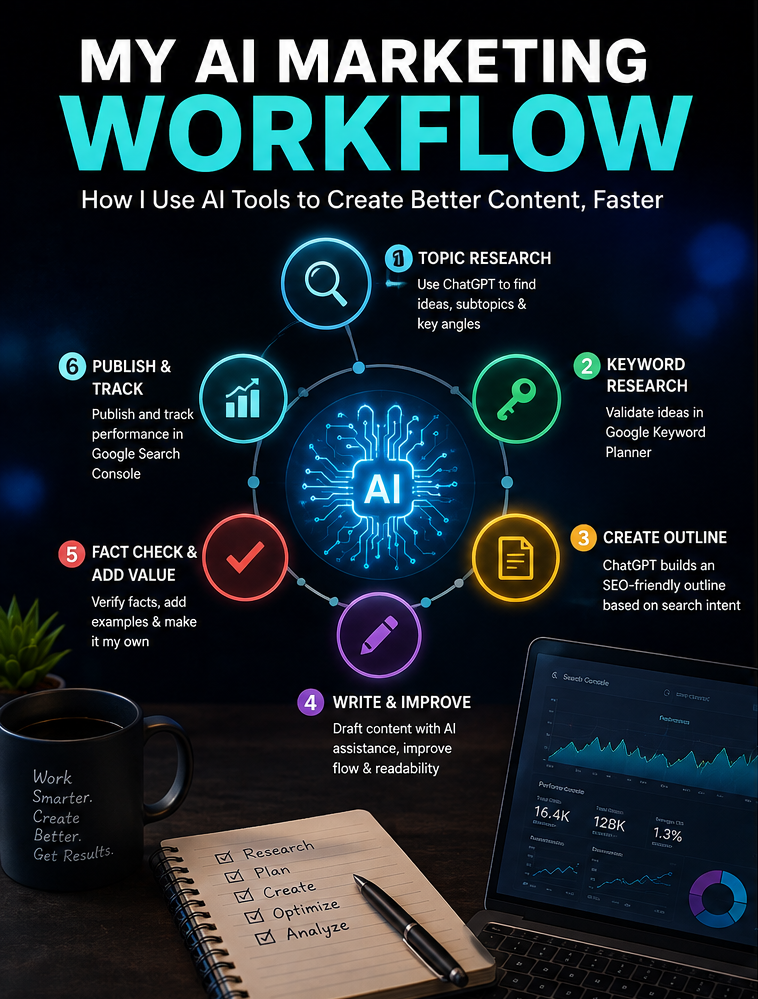
. I look into the topic. Ask ChatGPT to find subtopics, common questions and angles that competitors might be missing.
. I group. Check them in Google Keyword Planner.
. I create the outline. ChatGPT organizes headings in an order based on what people are searching for.
. write sections. Improve each section using the outline as a guide, not as a script.
. I make it easier to read and better for SEO by asking for ideas on making sentences, adding transitions and improving the flow.
. I check facts, add my examples and rewrite anything that sounds too general.
Example: How It Changed My Workflow
For example, I cut the time to make a draft from 6 hours to 2 hours.
One example of this method in action was an SEO blog post I wrote titled “How to Build Topical Authority That Actually Ranks.” Usually setting up a post like that takes me around 5 to 6 hours.
I used ChatGPT to create the outline and organize headings. I had a first draft ready in about 2 hours.
After that I still spent time checking and improving it manually, checking facts, adjusting the structure and making sure it matched my way of speaking.
The result was an SEO article made in less time than usual. To be honest the article is new. I do not have ranking data to share yet.
What I can say for sure is that the effect on how I work and the quality of content, the time from start to finish dropped a lot. The structure came out better than my try.
This is a point: if you are looking into AI tools for marketing, the clear benefit is speed and structure and ranking improvements depend on more than just tools.
Content quality, backlinks and competition all have a role too.
A Common Error I Have Seen
A common error is publishing AI output as it is, which is a mistake I have seen. One I have had to make sure I avoid myself is copying AI-generated content and putting it out without checking.
AI can create information if you do not check it.
I learned this from a draft. It might sound okay on the outside, miss details, use numbers or make claims that do not hold up.
My rule now is AI should help your work, not take over your job.
Every piece of content I use it for still goes through:
. Fact-checking
. Adding my thoughts and experience
. SEO optimization based on keyword data, not AI ideas
. A final check to make sure it fits the people reading it
Google and Content Quality
This is not a choice; it also matches how Google looks at content for experience, knowledge, authority and trust when deciding what to rank.
Content that is clearly checked and added to by a person tends to last than just AI output.
AI and SEO Tools That Work Well Together
AI tools for digital marketing can work well with SEO tools. I use Canva AI for media graphics and presentation design, especially when I need to create content without a design background.
Google Keyword Planner is used to check the keyword ideas ChatGPT suggests since AI-generated keyword lists are not always supported by search numbers.
Combining AI tools for digital marketing with SEO tools makes the process more effective.
Google Search Console is used to track how content actually works after it is published and to know when it is time to update a post.
Using these together or just using one tool for everything is what makes the process better instead of just faster.
Where AI Tools Fall Short
AI tools for digital marketing are not a shortcut to higher rankings; they will not replace thinking.
A point to know:
. AI-suggested keywords still need to be checked against search data.
. Prompts create outlines; the more specific your input, the better the result.
. Ranking success depends on things AI cannot control, like backlinks, website strength and how fresh the content’s over time.
. If a tool or guide says using AI will get guaranteed traffic or rankings, that’s a warning sign to be careful.
One Tip for Beginners
Starting out, one tip for people using AI digital marketing tools is to not try to automate everything at once.
Start with one task:
. Use ChatGPT to make a blog outline.
. Generate a list of keyword ideas.
. Write a few social media captions.
. Then check, edit and make it your own before putting anything out.
This way you learn how the tool works, where it is good and where it needs fixing while keeping your content original and good for readers.
Frequently Asked Questions
What AI tools are for marketing?
It depends on the work.
ChatGPT is good for content research, outlining and improvement.
Canva AI is helpful for design work while Google Keyword Planner and Search Console handle keyword research and performance tracking.
Can AI tools replace a marketer?
No.
AI tools make research, writing and setting up strategy faster.
Fact-checking, brand voice and final quality check still need a person involved.
Is AI-generated content for SEO automatically good?
No.
Content from AI that is not checked and too general can hurt rankings and trust.
Checking, fact-checking and adding knowledge before putting it out is what makes content that works from content that does not.
How much time can AI tools really save?
In my experience, using ChatGPT for outlining and setting up cuts a 5–6 hour drafting time down to about 2 hours for the first draft even though checking and improving still takes time afterward.
Conclusion
Finally, using AI tools for digital marketing tools properly comes down to seeing them as a tool to make work easier, not as a replacement for knowledge.
Use ChatGPT for research, outlining and improvement, not for copying. Check facts, add your thoughts before putting anything out.
Use AI writing tools with design and analysis tools, for a process.
Start with one task at a time, check and make it your own. It beats trying to automate everything at once.
The marketers who get the most from AI are not the ones who use it the most; they’re the ones who know when to stop and add their thinking.
If you’re looking for practical digital marketing strategies and professional support, visit my website to learn more about how a digital marketing expert in Thrissur can help improve your online presence.